The impact of weather conditions I: The wind
When preparing for a track test, there are usually factors beyond our control that can alter the interpretation of the results.
Weather is one of the most influential variables, and in this article we will review one of its most critical components: wind.
Wind affects a vehicle in multiple ways, making its study essential in both motorsport and automotive engineering. Depending on its direction, intensity, and consistency, it can alter vehicle balance, top speed, braking points, and downforce generation.
Being able to replicate these conditions allows both engineers and drivers to anticipate what to expect before going on track, saving a significant amount of time
In this article we will carry out a test where we will explore the longitudinal effects of the wind in our vehicle.
To obtain meaningful results, we have prepared simulations with different directions and intensities of wind. It would also be possible to apply a variable wind profile over time, but to ensure consistency, we will keep it constant throughout these runs.
Below we can see how we can properly set up the wind conditions, both intensity and directionwise. The minimap can be used to ensure that the direction is correct.
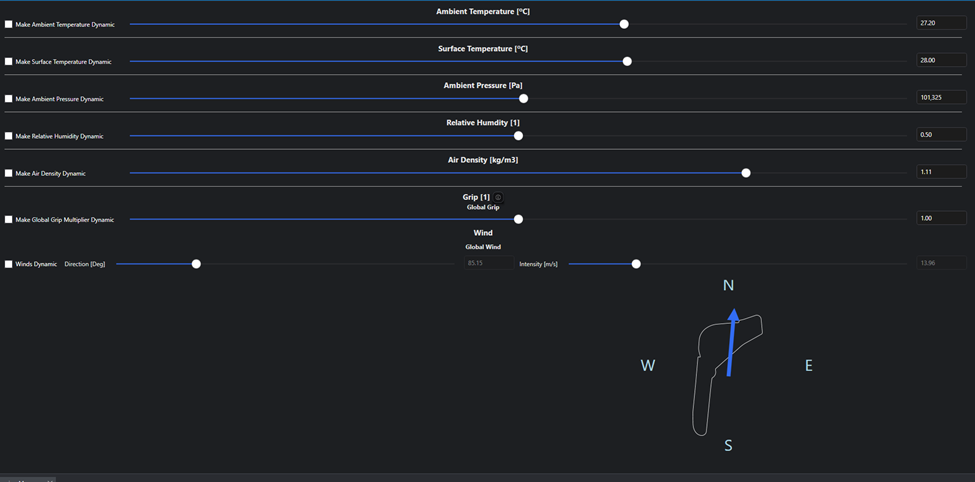
The analysis will be divided into two sections: Top speed and braking performance.
Top speed
For this first test we prepared two simulations, one with 50kmh of tailwind, and one with no wind, all carried out in a flat environment so we can achieve with no perturbance the terminal speed.
It stands by itself that the vehicle with tailwind will be faster in a straight line than one without wind. But how much?
We could expect the difference to be exactly the wind intensity, 50kmh, so let's check if it is the case.
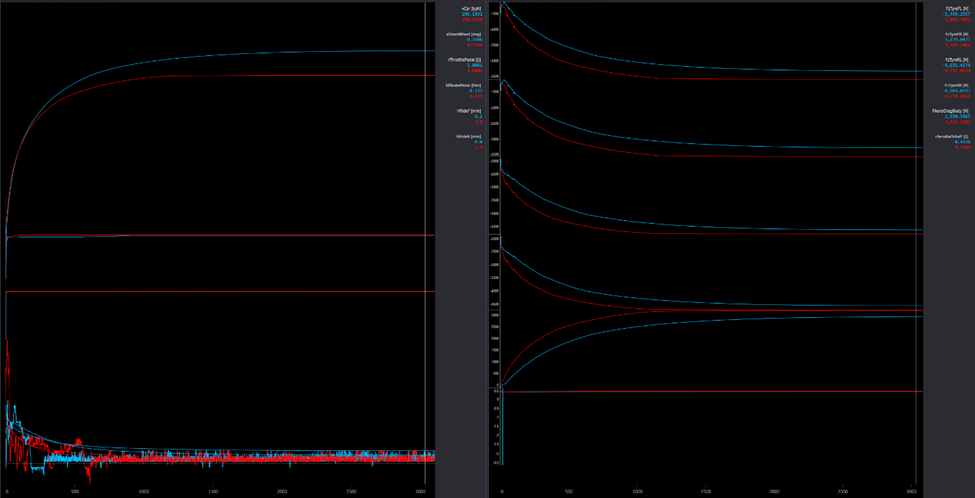
As we can see, the vehicle with tailwind achieves a top speed of 296,18 while the vehicle with no wind goes up to 258.56 kmh, being the difference between both of 37,62 kmh.
So why is this the difference and not the 50kmh that we were expecting? Let's find out!
First, a short introduction into aerodynamics, and mostly how drag is generated.
The equation that defines the drag force is the following:
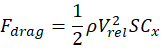
Where:
- ρ: air density
- V_rel: relative speed (vehicle speed relative to the air)
- S: frontal area of the car.
- C_drag: lift coefficient (dependent on design, wings, and ride height configuration)
*In most aeromanuals, S and Cx appear combined into a CxS coefficient.
As a side note, the downforce equation is identical, replacing the drag coefficient with the lift coefficient. The ratio between them defines aerodynamic efficiency.
A key point here is that relative speed is not the same as ground speed. This distinction is critical and will be explored further.
According to the drag equation, if all variables remain constant except relative speed, theory suggests that the terminal ground speed difference between both cases should be exactly 50 km/h. This would imply identical relative speeds, and therefore identical ride heights and downforce levels.
Then why isn't that the case?
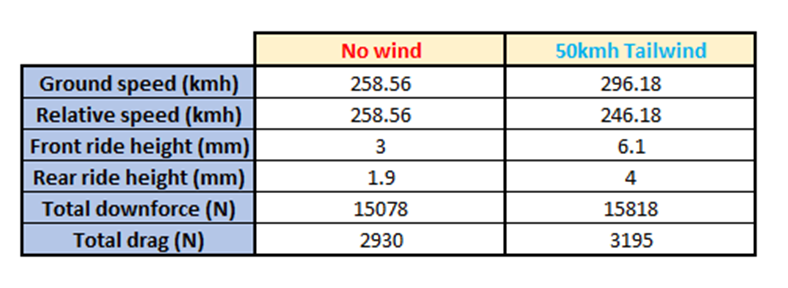
Well that's because the top speed is not only determined by drag vs engine power, but also by the friction losses.
As vehicle and engine speed increases, internal losses also increase. Bearings, shafts, and gears are all in contact, generating friction that reduces the effective force delivered to the wheels. The rolling resistance from the tyres themselves also increases with speed.
Additionally, both cars are running in the same gear, meaning the faster car operates at higher RPM and produces more power according to the engine curve. However, the impact of friction losses is so significant that it not only offsets this power gain, but also the expected aerodynamic advantage.
Then, to sum up, the top speed is met when the following equation takes place:

As a result, the car with lower ground speed actually experiences higher relative speed than the car assisted by the tailwind. This leads to higher downforce and lower ride height, which final value will depend on how our vehicle and tyres are modelled.
So, in general, with tailwind we should lower the car to match the end of straight ride height, and not raise it, even if the ground speed is quicker.
A bit contraintuitive isn't it?
Braking Performance
To analyze pure braking performance, we will evaluate how wind affects braking efficiency, and therefore how much the braking point needs to be adjusted under different conditions. Wintax4 will be used after a quick export.
The test is carried out on the main straight of Monza, taking place three simulations, one with tailwind of 50kmh, another one with headwind of the same intensity and one without wind.
For this analysis, we will plot brake pressure versus longitudinal acceleration in an XY graph.
Next to it, we will include a distance-based graph showing the speed delta caused by the wind, along with the difference in braking points.
For the following analysis:
- Green: 50 km/h headwind
- Red: 50 km/h tailwind
- Blue: no wind
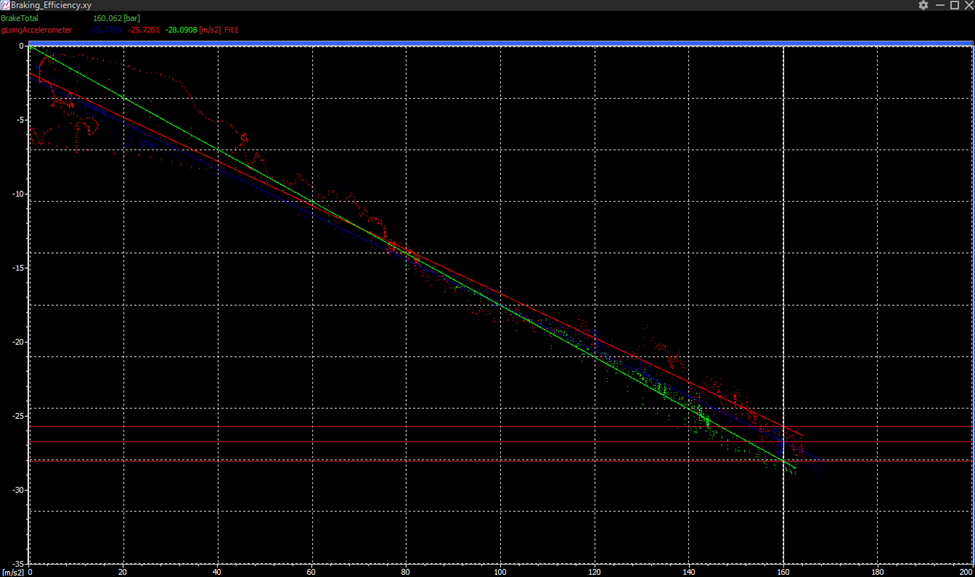
As seen in the XY plot, at 160 bar of total brake pressure, the headwind case (green) achieves 2.809 G, while the no-wind case (blue) reaches 2.677 G, and the tailwind case (red) achieves 2.572 G.
How does this translate into braking distance?
Let’s look at the time/distance graph.
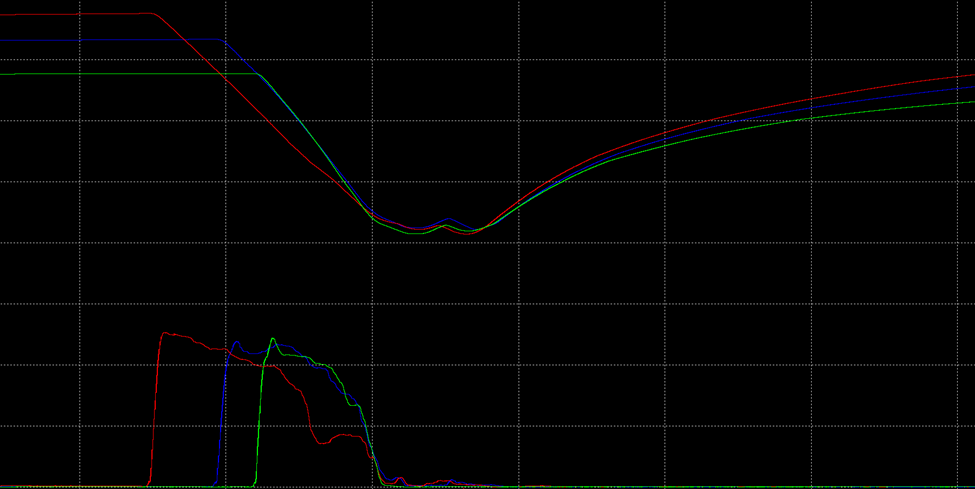
The headwind case brakes 80 m before the corner (and with a more talented driver than myself, probably even later to match blue's entry speed). The no-wind case brakes approximately 25 meters earlier, and the tailwind case about 45 meters earlier than the no-wind case.
This large difference is not only due to braking efficiency—which defines the slope of the speed reduction—but also due to the speed difference at the end of the straight, which can be close to 100 km/h between the no-wind and tailwind cases.
Conclusion
To sum up, knowing in advance the effects of the wind in terms of braking and top speed, is a clear competitive advantage that shouldn't be underrated, both in terms of engineering - being able to anticipate setup changes or expect results - and driving, where knowing how to adapt your braking point in relation to the wind, can make a huge difference and avoid mistakes.
Liked this article? Here is the one from last week!
 Antonio Ortiz Poveda